Orbit Placement
Reviewed field entry.
This page explains a term used by Anatomy Steward’s digital museum and teaching resources.
Entry context: Anatomy Steward Wiki › Osteology › Orbit Placement
Definition
Section titled “Definition”Orbit placement refers to where the eye sockets are positioned and how they face relative to the skull.
Why It Matters
Section titled “Why It Matters”Orbit placement can support discussion of visual field, depth perception, and sensory orientation.
Museum Use
Section titled “Museum Use”It appears in skull comparison labels and visitor prompts, especially when contrasting carnivoran and herbivore skulls.
Teaching Use
Section titled “Teaching Use”Ask learners to describe orbit direction before making an inference. Are the orbits more forward-facing, lateral, or intermediate?
Cautions
Section titled “Cautions”Eye placement is a clue, not a rule. It should be interpreted with teeth, jaw form, ecology, and related structures.
Diagram to Add
Section titled “Diagram to Add”A future diagram for this entry should show:
- Skull front/top comparison showing forward-facing and lateral orbit tendencies.
- Include interpretation caution that orbit placement is not a single rule.
Diagram notes: use calm educational line art, clear labels, alt text, image credit, and rights status.
Related Terms
Section titled “Related Terms”Related Museum Pages
Section titled “Related Museum Pages”- Generalized Carnivoran Skull
- Generalized Herbivore Skull
- Skulls, Teeth, and Diet Exhibit
- Anatomy Steward Digital Museum
Sources and Further Reading
Section titled “Sources and Further Reading”The following public sources support this entry. They are provided for definition review, teaching context, museum documentation language, or rights/digital preservation context.
- Animal Diversity Web — Mammalia — Public source with mammalian skull views and orbital region references.
- Animal Diversity Web — Spinning Skulls — Public teaching resource for observing skulls from multiple views.
- Smithsonian National Museum of Natural History — Forensic Anthropology — Museum education source useful for teaching that skeletal clues require careful interpretation.
Source Review Note
Section titled “Source Review Note”These sources are public references for educational and museum documentation use. They do not replace professional, legal, conservation, taxonomic, or collection-specific review.
Diagram
Section titled “Diagram”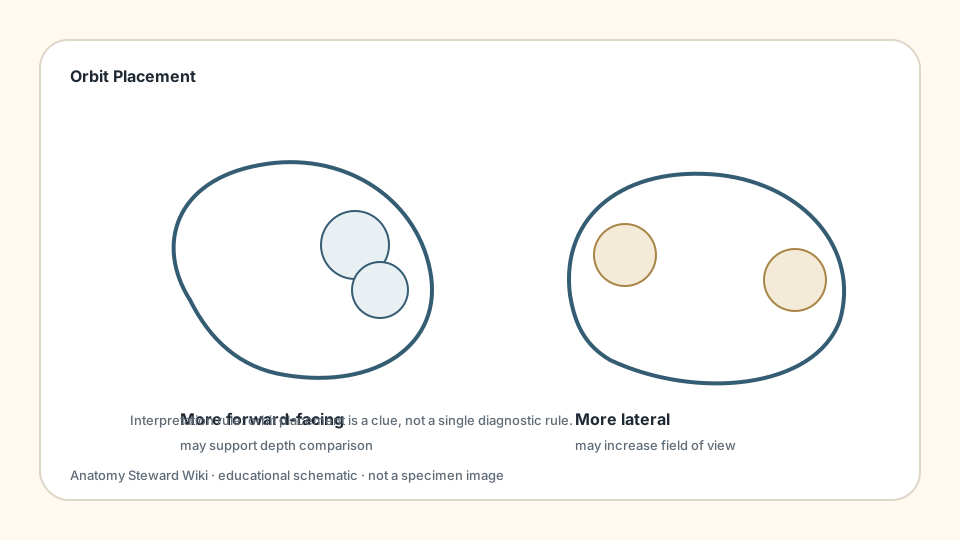
Key Observations
Section titled “Key Observations”- Direction of the eye sockets
- Relative forward or lateral placement
- Relationship to skull width
- Whether other features support the same interpretation
Common Misunderstandings
Section titled “Common Misunderstandings”- Orbit placement is not a universal predator/prey rule.
- Visual field cannot be fully reconstructed from a skull alone.
- Eye placement must be interpreted with other evidence.
Field Note
Section titled “Field Note”Orbit placement is valuable mainly as a caution lesson: visible anatomy can suggest, but not prove.
Mini Teaching Activity
Section titled “Mini Teaching Activity”Ask learners to compare orbit placement in two skulls, then list what they can infer and what they cannot infer.
Contribution Ideas
Section titled “Contribution Ideas”This entry can be improved with:
- Introductory visual perception references
- Safer public wording for eye placement
- Museum examples of skull comparison labels
Search Keywords
Section titled “Search Keywords”orbit placement, eye socket, forward-facing eyes, lateral eyes
Teacher Use
Section titled “Teacher Use”Use this entry to teach caution. Ask students what orbit placement may suggest and what it cannot prove.
Improve This Entry
Section titled “Improve This Entry”Help improve this reviewed wiki entry.
See a clearer definition, better public source, correction, teaching use, or image lead?
📝 Suggest a Correction, Source, or Teaching Use
Suggestions may include:
- a public source
- a correction or safer wording
- a related museum page
- a teaching activity
- an image or diagram lead with clear rights information
- a question that would make this entry easier to understand
Reviewed Status
Section titled “Reviewed Status”Version 2 field note. This page is part of the reviewed Anatomy Steward Wiki and is not open for direct public editing. Suggestions should be submitted through the reviewed contribution process.
Cite this term
Anatomy Steward Wiki. “Orbit Placement.” Anatomy Steward Wiki. https://wiki.anatomysteward.com/osteology/orbit-placement/